Skip to main content
Accident Guide, Accident Statistics, Blog, Car Accident, Personal Injury, Safety Awareness
Why These States Ranked Among the Most Dangerous in 2025
Updated for 2026
New for 2026: Updated State Risk Rankings
See the latest nationwide rankings, updated risk factors, and new state-by-state analysis in our 2026 report.
View the Updated 2026 Rankings →Updated with 2026 accident, weather, insurance claim, and risk data.
Every year, millions of Americans are affected by:
- Car accidents
- Severe weather
- Property damage
- Violent crime
- Insurance disputes
But where you live plays a major role in your level of risk.
What Makes These States More Dangerous?
These rankings are based on several overlapping risk factors that contribute to higher accident rates, property damage losses, insurance disputes, and injury claims.
Car Accidents
High fatality rates, congested highways, distracted driving, and severe crashes contribute to elevated roadway risk.
Property Damage
Hurricanes, flooding, tornadoes, roof damage, and water intrusion create major insurance and repair concerns.
Severe Weather
Storm-prone states face increased risks from hurricanes, hail, flooding, winter storms, and high winds.
Insurance Disputes
High claim volume can lead to delayed payments, denied claims, low settlement offers, and complex disputes.
Truck Accidents
Major trucking corridors and commercial traffic increase the likelihood of catastrophic highway collisions.
Uninsured Drivers
Some states report significantly higher rates of uninsured motorists, creating additional financial risk after accidents.
Injured or dealing with property damage?
Find out whether you may have a claim and what steps to take next.
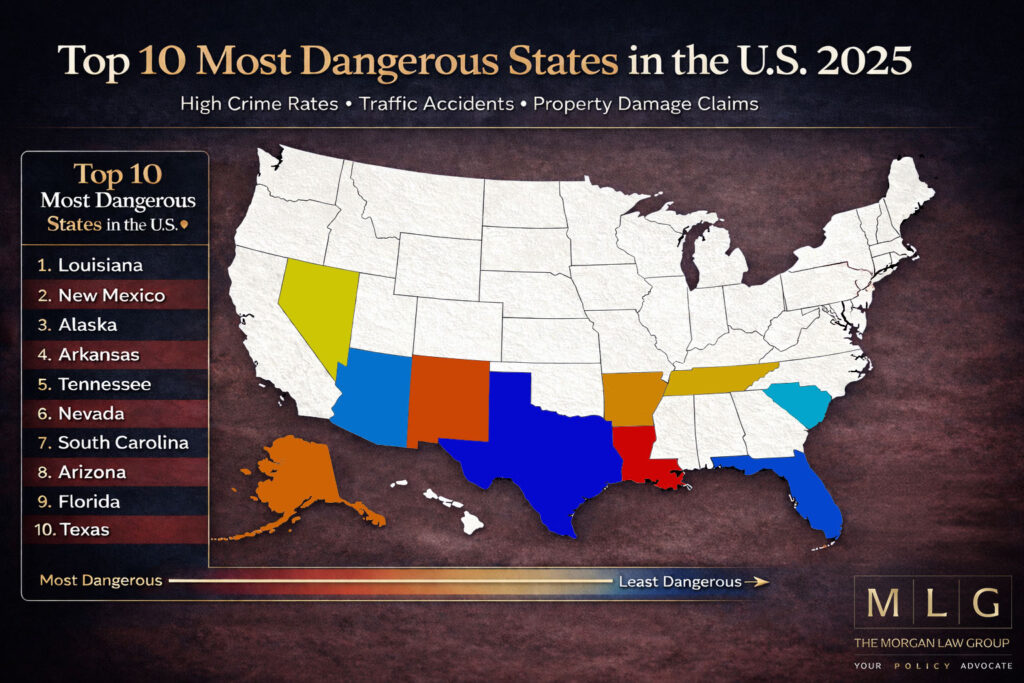
Top 10 Most Dangerous States in the U.S. (2025)
#1
Louisiana
Louisiana consistently ranks among the most dangerous states due to severe weather exposure, roadway fatalities, and high insurance claim activity.
#2
New Mexico
New Mexico faces elevated risks from serious roadway accidents, rural highway conditions, and increasing injury-related claims.
#3
Alaska
Harsh winter conditions, remote travel routes, and limited emergency access contribute to Alaska’s elevated risk profile.
#4
Arkansas
Arkansas reports elevated roadway fatalities, severe weather losses, and insurance concerns involving uninsured drivers.
#5
Tennessee
Tennessee continues to experience severe weather losses, accident claims, and increasing insurance disputes.
#6
Nevada
Nevada faces increased accident frequency due to tourism traffic, congestion, and distracted driving risks.
#7
South Carolina
South Carolina consistently ranks high for fatal crashes, dangerous roads, and weather-related property damage.
#8
Arizona
Arizona’s growing population and heavy roadway congestion contribute to rising accident and insurance claim activity.
#9
Florida
Florida remains one of the highest-risk states because of hurricanes, severe traffic congestion, tourism accidents, and insurance disputes.
#10
Texas
Texas experiences a high volume of truck accidents, severe weather claims, and major highway collisions.
Updated for 2026
How Have The Rankings Changed Since 2025?
Some states moved up and down in the rankings based on updated accident statistics, weather events, insurance claim trends, and population risk factors.
See Our 2026 Report Here →Featured Resource
The Morgan Law Group Resource Center
Find legal resources, insurance claim guides, personal injury information, property damage resources, and state-specific updates for Florida, Louisiana, Georgia, Mississippi, North Carolina, and Texas.
How Risk Turns Into Real Claims
In high-risk states, accidents and severe weather often lead to insurance claims, financial losses, and legal disputes.
01
Accident or Damage Occurs
A serious accident or storm creates immediate medical, financial, and property damage concerns.
- Vehicle collisions
- Storm damage
- Roof and water damage
02
Insurance Claim Filed
Property owners and injury victims begin documenting losses, repairs, and medical expenses.
- Photos and evidence
- Repair estimates
- Medical records
03
Claim Disputes Begin
Insurance companies may delay communication, dispute damages, or offer low settlements.
- Delayed claims
- Denied coverage
- Low settlement offers
04
Recovery & Legal Options
Injury victims and property owners may pursue additional compensation and claim review options.
- Settlement review
- Claim negotiation
- Legal guidance
Your insurance company may not be offering full value
Before accepting any settlement, find out what your claim may actually be worth.
Dangerous Cities and Roads in High-Risk States
Many of the nation’s most dangerous accident patterns are concentrated in heavily populated metro areas and high-traffic highway corridors.
Cities frequently associated with elevated accident and insurance claim activity include:
- Miami
- Fort Lauderdale
- New Orleans
- Atlanta
These areas often experience:
- Rear-end collisions
- Truck accidents
- Multi-vehicle crashes
- Pedestrian injuries
- Insurance disputes
Helpful local resources:
- Who Pays Medical Bills After a Crash in Fort Lauderdale?
- Miami Claims
- New Orleans Claims
- Atlanta Claims
- Fort Lauderdale Claims
- How Car Accident Settlements Work in Atlanta
Why These States Rank Higher
Traffic Volume and Population Growth
More people and more vehicles usually lead to:
- Increased congestion
- More accidents
- Higher insurance claim frequency
Helpful resources:
Severe Weather and Property Damage
States exposed to hurricanes, flooding, tornadoes, hail, and winter storms often report more property damage losses.
Helpful resources:
- Storm Damage Claims
- Hurricane Damage Claims
- Roof Damage Claims
- Water Damage Claims
- Property Damage FAQs
Insurance Claim Disputes
In high-risk states, insurance companies process a massive number of claims each year. This can lead to:
- Delayed claims
- Low settlement offers
- Excessive documentation requests
- Denied claims
Helpful resources:
- Insurance Settlement Too Low?
- Property Damage Claim Settlement Process
- How to Dispute a Property Damage Claim Settlement
- Denied Insurance Claims
Your Insurance Company May Not Be Offering Full Value
Before accepting any settlement, find out what your claim may actually be worth.
Signs Your Claim May Be Undervalued
Your claim may be undervalued if:
- The settlement offer seems unusually low
- The insurance company delays communication
- You are asked for excessive documentation
- Your claim is denied without explanation
Helpful resources:
Car Accident Injuries in High-Risk States
If you were injured in a car accident, you may be eligible to pursue compensation for:
- Medical expenses
- Lost wages
- Pain and suffering
- Vehicle damage
Helpful resources:
Property Damage and Insurance Claims
If your property was damaged by:
- Hurricanes
- Flooding
- Storms
- Roof damage
- Water intrusion
you may be entitled to additional compensation beyond the insurance company’s initial offer.
Helpful resources:
- Storm Damage Claims
- Hurricane Damage Claims
- Roof Damage Claims
- Water Damage Claims
- Property Damage Claim Settlement Process
How These Rankings Were Determined
This ranking considers:
- Accident frequency
- Severe weather exposure
- Property damage claims
- Insurance dispute trends
- Population-adjusted safety risk
States with consistently elevated accident, property damage, and insurance claim activity ranked higher overall.
What Changed in the 2026 Rankings?
Risk levels continue to shift year over year because of:
- Population growth
- Severe weather patterns
- Increased accident frequency
- Insurance claim trends
See the newest rankings here: Most Dangerous States in the U.S. (2026)
Frequently Asked Questions
What is the most dangerous state in the U.S.?
The most dangerous state can change year to year depending on accident rates, violent crime, severe weather exposure, and insurance claim activity. Louisiana ranked among the highest-risk states in 2025.
Why is Florida considered a dangerous state?
Florida ranks high because of heavy traffic, hurricanes, flooding, tourism-related crashes, and a large volume of insurance claims and disputes.
Why do some states have more insurance disputes?
States with more storms, accidents, and property damage claims often generate more insurance disputes because insurers process a larger volume of claims.
What should I do after an accident?
Seek medical care, document the scene, preserve evidence, and avoid accepting a settlement before understanding the full value of your claim.
Can a denied insurance claim still be challenged?
Yes. Many denied or underpaid claims may still be reviewed, disputed, or reopened depending on the circumstances and policy language.
Do Not Wait to Take Action
Every state has strict deadlines for:
- Personal injury claims
- Property damage claims
- Insurance disputes
Waiting too long can:
- Reduce available evidence
- Limit your legal options
- Affect the value of your claim
If you were injured or your property was damaged, it is important to understand your options before accepting an insurance company’s offer.
Get Answers About Your Claim
Learn what options may be available after an accident, injury, or property damage loss.
Related Reading