Skip to main content

Car Accident Claims, Personal Injury
Injured in a Car-Dooring Accident in Atlanta: Who May Be Liable?
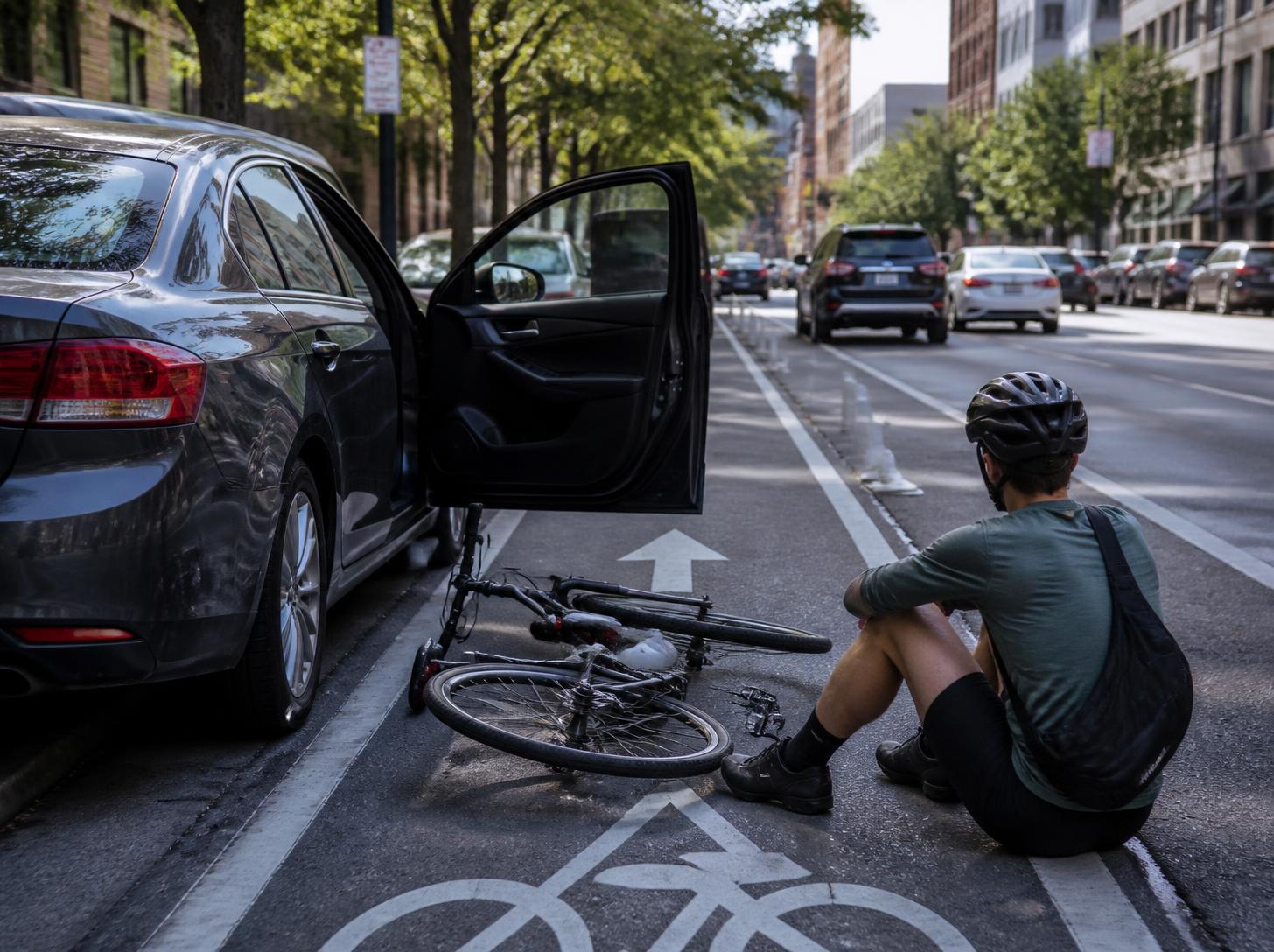
An Atlanta car-dooring accident claim may arise when a driver or passenger opens a vehicle door into the path of a bicyclist, motorcyclist, scooter rider, or other approaching road user. The impact can throw the rider into traffic, onto the pavement, or against another vehicle, causing serious injuries even when the parked vehicle never moves.
Determining liability requires more than identifying who opened the door. The investigation may also consider where the vehicle was parked, whether the person looked for approaching traffic, how long the door remained open, the rider’s path and speed, visibility, available surveillance footage, and whether another driver contributed to the collision.
Quick Answer
Driver Who Opened the Door
A driver may be liable for opening a door into moving traffic without first determining that it could be done safely and without interfering with an approaching rider.
Passenger Who Opened the Door
A passenger may also bear responsibility when that passenger opened the door without checking for a bicyclist, motorcyclist, scooter rider, or other approaching traffic.
Employer or Commercial Operator
Additional liability questions may arise when the door was opened by someone working from a delivery vehicle, rideshare vehicle, taxi, service truck, or other commercial vehicle.
Multiple Parties
An insurer may argue that the injured rider or another road user shares fault. Georgia’s comparative-fault rules can affect the amount recoverable, making evidence about each person’s actions important.
The Georgia Department of Driver Services explains that opening a vehicle door on the side where traffic is moving is prohibited unless it is safe and can be done without interfering with other traffic, including bicyclists operating near parked vehicles.
This article explains how fault may be evaluated after an Atlanta dooring collision, which parties and insurance policies may be involved, what evidence should be preserved, and how allegations of shared fault can affect an injury claim. For broader information about resolving vehicle claims in the city, review our guide to how car-accident settlements work in Atlanta.
Liability and compensation depend on the specific facts, available evidence, applicable insurance coverage, and current Georgia law. This article provides general information and is not legal advice.
What Duty Does Someone Have Before Opening a Vehicle Door?
Georgia’s traffic rules require a person to make sure that opening a vehicle door into moving traffic can be done safely. The rule applies to traffic approaching alongside parked or stopped vehicles, including bicyclists traveling near the line of parked cars.
The Georgia Department of Driver Services states that opening a vehicle door on the traffic side is prohibited unless it is safe and can be done without interfering with the movement of other traffic. A violation may become important evidence of negligence, although liability still depends on the complete circumstances of the collision.
| Issue | Question the Investigation May Address | Evidence That May Matter |
|---|---|---|
| Observation before opening | Did the driver or passenger check the mirror, look over a shoulder, or otherwise check for approaching traffic? | Statements, surveillance video, dashcam footage, witness accounts, and vehicle position |
| Timing of the door movement | Was the door opened suddenly when the rider was already too close to stop or move safely? | Video timestamps, rider and witness statements, impact location, and travel-speed evidence |
| Interference with traffic | Did the opened door enter a bike lane, travel lane, or other path being used by an approaching road user? | Roadway photographs, lane markings, measurements, diagrams, and police observations |
| Length of time the door remained open | Was the door opened directly into the rider’s path, or had it been visibly open long enough to be avoided? | Surveillance footage, witness accounts, physical evidence, and the sequence of events |
| Parking position | Was the vehicle legally and predictably parked, or was it stopped in a travel lane, bicycle lane, loading area, or another unsafe position? | Parking signs, curb markings, photographs, citations, vehicle-location data, and nearby business video |
| Actions after opening | Did the person leave the door open, step into the rider’s path, or fail to warn approaching traffic? | Witness statements, video, emergency-call records, and the location of the person and door after impact |
A Traffic Violation Does Not Automatically Resolve Every Issue
Evidence that a door was opened unsafely may strongly support a claim, but insurers may still dispute causation, the rider’s actions, the severity of the injuries, or which insurance policy applies. The injured person must still connect the unsafe conduct to the collision and document the resulting losses.
The official Georgia Department of Driver Services guidance on opening vehicle doors specifically recognizes bicyclists traveling near parked vehicles as part of the traffic that must not be obstructed.
Who May Be Responsible for an Atlanta Car-Dooring Accident?
The person who opened the vehicle door is often central to the liability investigation, but other individuals or businesses may also be involved. Each potentially responsible party should be evaluated separately based on that party’s conduct, relationship to the vehicle, and available insurance coverage.
The Driver
A driver may be liable for opening the driver-side door into the path of an approaching bicyclist, motorcyclist, scooter rider, or vehicle without first checking that the movement could be completed safely.
A Passenger
A passenger may bear responsibility when the passenger opened a roadside door without checking for approaching traffic. The passenger’s own liability coverage may need to be investigated.
The Vehicle Owner
Ownership alone does not necessarily establish liability. Additional questions may arise when the owner entrusted the vehicle to another person, controlled its use, or has insurance applicable to the incident.
An Employer
An employer may be implicated when an employee opened the door while performing job duties, making a delivery, transporting equipment, or otherwise acting within the scope of employment.
A Rideshare or Delivery Company
A rideshare, delivery, courier, or transportation platform may present additional insurance and agency questions depending on the worker’s status and activity when the collision occurred.
Another Road User
A moving driver may contribute by following too closely, passing unsafely, entering a bicycle lane, or striking the injured rider after the initial door impact or evasive maneuver.
Liability and Insurance Coverage Are Separate Questions
Identifying negligent conduct does not automatically identify the policy that must pay the claim. Coverage may depend on whether the person was a driver or passenger, owned the vehicle, lived with another insured person, or was working for a business at the time.
The investigation may involve a personal automobile policy, commercial vehicle policy, employer liability coverage, rideshare or delivery coverage, homeowners or renters liability coverage, and the injured person’s own uninsured or underinsured motorist protection. Policy notices and requests should be made promptly so potentially applicable coverage can be identified and preserved.
What Evidence Should Be Preserved After a Car-Dooring Accident?
Dooring collisions often happen quickly, and the parties may give conflicting accounts of whether the door opened suddenly, how close the rider was to the parked vehicle, and whether the collision could have been avoided. Prompt evidence preservation can help reconstruct the sequence.
01
Document the Scene
Photograph and record the parked vehicle, opened door, bicycle or motorcycle, debris, blood, skid marks, bike-lane markings, curb, nearby signs, visibility conditions, and overall roadway layout.
- Take wide and close views.
- Record the direction each person traveled.
- Measure relevant distances when practical.
02
Locate Video Quickly
Nearby businesses, homes, parking facilities, buses, rideshare vehicles, delivery vehicles, and other motorists may have recorded the collision. Some systems overwrite footage within days.
- Identify every visible camera.
- Request preservation promptly.
- Keep copies in their original format.
03
Identify Witnesses
Independent witnesses may describe whether the door opened suddenly, whether the rider was visible, how the vehicle was parked, and what the parties said immediately afterward.
- Collect names and contact information.
- Record where each witness was positioned.
- Preserve written or recorded statements.
04
Preserve Physical and Digital Evidence
The damaged door, bicycle, helmet, clothing, lights, reflectors, mobile devices, navigation data, fitness-app records, and vehicle information may help establish impact location and movement.
- Photograph property before repairs.
- Preserve damaged equipment and clothing.
- Export relevant digital data without altering it.
Statements Made at the Scene May Also Matter
A driver or passenger may apologize, admit that the rider was not seen, or explain that the door was opened without checking. Record the substance of those statements and identify anyone who heard them. Do not argue about fault or pressure someone to make an admission.
The police report may identify the parties, witnesses, vehicle, insurance information, roadway conditions, and any citation issued. However, it may not include nearby surveillance footage or every fact needed to establish liability.
For additional guidance, review our article about the evidence that may help prove liability after an accident.
Were You Injured When Someone Opened a Car Door Into Your Path in Atlanta?
The Morgan Law Group can investigate the dooring collision, preserve available video and witness evidence, identify potentially responsible parties, review the applicable insurance coverage, and evaluate allegations of shared fault.
Can Allegations of Shared Fault Reduce an Atlanta Car-Dooring Accident Claim?
Yes. Under Georgia’s modified comparative-fault rule, compensation may be reduced in proportion to the injured person’s percentage of responsibility. If the injured person is found 50% or more responsible for the injury or damages claimed, recovery is barred.
Because of that threshold, an insurer may try to shift substantial fault to a bicyclist, motorcyclist, or scooter rider even when a driver or passenger opened a vehicle door into the rider’s path.
| Assigned Fault | Effect Under Georgia’s Rule | Example Using $100,000 in Damages |
|---|---|---|
| 0% to the injured person | No comparative-fault reduction applies. | The potential recovery remains $100,000. |
| 20% to the injured person | The damages are reduced by 20%. | The potential recovery becomes $80,000. |
| 49% to the injured person | The damages are reduced by 49%, but recovery is not completely barred. | The potential recovery becomes $51,000. |
| 50% or more to the injured person | Georgia law bars recovery. | The injured person recovers nothing under this example. |
The figures above are simplified examples. An actual result depends on the proven damages, allocation of fault, available insurance, legal rulings, and other case-specific issues.
Arguments an Insurer May Raise Against the Injured Rider
The insurer may allege that the rider was traveling too close to parked vehicles, moving too fast for conditions, distracted, traveling against traffic, not using required lighting at night, or failed to react to a door that had already been open long enough to see.
Those allegations should be tested against the actual evidence. Video footage, impact location, roadway design, bike-lane markings, visibility, witness accounts, damage patterns, digital data, and the timing of the door movement may show that the rider had little or no reasonable opportunity to avoid the collision.
Opening the Door Unsafely Remains Important
A rider’s obligation to use reasonable care does not eliminate the separate duty to avoid opening a vehicle door into moving traffic. The conduct of the door opener, injured rider, and any other contributing party must be evaluated individually.
What Compensation May Be Available After an Atlanta Car-Dooring Accident?
A dooring collision can cause more than an immediate impact injury. A bicyclist, motorcyclist, or scooter rider may be thrown onto the pavement, pushed into moving traffic, or forced to make an evasive maneuver that causes a second collision.
The value of the claim depends on the injuries, treatment, recovery, financial losses, long-term effects, available evidence, allocation of fault, and applicable insurance coverage.
Medical Expenses
The claim may include emergency transportation, hospital care, surgery, imaging, physician visits, medication, physical therapy, assistive devices, and other reasonable injury-related treatment.
Future Medical Care
Serious fractures, head injuries, spinal injuries, scarring, or joint damage may require future treatment, rehabilitation, additional procedures, medication, or long-term medical support.
Lost Income
An injured person may seek compensation for missed work, reduced hours, lost employment benefits, used leave, and other documented income losses caused by the collision and recovery.
Reduced Earning Capacity
When lasting limitations affect the person’s ability to perform the same occupation or earn income in the future, the claim may include diminished earning capacity supported by appropriate evidence.
Pain and Other Effects
The claim may address physical pain, emotional distress, inconvenience, disfigurement, impairment, and loss of enjoyment of ordinary activities resulting from the injuries.
Property and Out-of-Pocket Losses
Document damage to the bicycle, motorcycle, scooter, helmet, clothing, electronics, safety equipment, and other property, along with transportation and other reasonable collision-related expenses.
Medical Documentation Connects the Injuries to the Collision
Seek appropriate medical attention and accurately describe how the collision occurred, where the body made contact, and how symptoms developed. Follow recommended treatment and preserve medical records, bills, prescriptions, work restrictions, and referral information.
Some injuries may not be fully understood during the initial emergency evaluation. Persistent headaches, dizziness, numbness, weakness, restricted movement, worsening pain, or other concerning symptoms should be reported to an appropriate medical professional.
Income losses should be supported with employer verification, wage statements, tax records, medical restrictions, and other available documentation. For additional guidance, review our article explaining whether an injured person can claim lost wages after an accident in Atlanta.
Which Insurance Coverage May Apply After an Atlanta Dooring Collision?
The person who caused the collision may have more than one potentially relevant policy. Coverage can depend on who opened the door, who owned the vehicle, whether the person was working, and how each policy defines an insured person, covered vehicle, and use of the vehicle.
| Potential Coverage | When It May Be Relevant | Important Claim Question |
|---|---|---|
| Vehicle liability insurance | The driver or another insured person opened a door of a covered vehicle into the injured rider’s path. | Does the policy treat the door-opening incident as arising from ownership, maintenance, or use of the vehicle? |
| Passenger’s liability coverage | A passenger rather than the driver opened the door. | Is the passenger covered under the vehicle policy, a household policy, or another applicable liability policy? |
| Commercial automobile coverage | The collision involved a taxi, delivery van, service vehicle, work truck, or another commercially insured vehicle. | Was the vehicle being used for business when the collision occurred? |
| Employer liability coverage | An employee opened the door while performing assigned work or acting within the scope of employment. | What was the worker doing, and how was that activity connected to the employer’s business? |
| Rideshare or delivery coverage | The driver or passenger was using a rideshare, courier, or delivery platform at the time. | What phase of the trip or delivery was underway, and which policy was active? |
| Uninsured or underinsured motorist coverage | The responsible person has no applicable liability insurance or insufficient coverage for the injuries. | Does the injured person’s policy and Georgia law extend UM or UIM coverage to the particular dooring collision? |
| Medical or health coverage | Medical bills require payment while the liability claim remains under investigation. | What reimbursement, lien, coordination, or subrogation rights may affect a later settlement? |
Do Not Assume the First Identified Policy Is the Only Coverage
A personal auto insurer may deny coverage because a passenger opened the door, while another policy may potentially protect that passenger. A commercial insurer may dispute whether the worker was acting within the scope of employment. A rideshare platform may contend that a different coverage period applied.
These disputes make it important to identify the vehicle owner, driver, passenger, employer, platform, and all potentially applicable policies. Written notice should be provided promptly, and any denial should identify the policy language supporting the insurer’s position.
When liability coverage is absent or inadequate, the injured person’s own insurance may require review. Our Georgia-focused article about being hit by an uninsured driver in Augusta provides additional background about uninsured-motorist issues, although coverage for a dooring collision depends on its own facts and policy language.
What Mistakes Can Weaken an Atlanta Car-Dooring Accident Claim?
Dooring cases frequently involve conflicting accounts and aggressive comparative-fault arguments. Avoiding preventable evidence and documentation problems can help preserve the injured person’s ability to establish how the collision occurred and how it affected their life.
Leaving Without Identifying Everyone
Obtain information for the driver, passenger who opened the door, vehicle owner, witnesses, employer, and any rideshare or delivery platform connected to the incident.
Waiting to Locate Video
Business, residential, parking, bus, and vehicle cameras may overwrite footage quickly. Delayed preservation efforts can result in the loss of the clearest evidence of timing and fault.
Repairing or Discarding Equipment
The bicycle, motorcycle, scooter, helmet, clothing, lights, and other damaged property may contain impact evidence. Photograph and preserve them before repair or disposal.
Giving a Speculative Statement
Describe what happened accurately without guessing about speed, distance, timing, or visibility. An uncertain estimate may later be presented as an admission of fault.
Ignoring Medical Symptoms
Delaying appropriate care or failing to report developing symptoms may make it harder to connect the injuries to the collision and document their full effect.
Accepting an Early Settlement
An early offer may arrive before the diagnosis, recovery period, future care, lost income, available coverage, and long-term limitations are fully understood.
Be Careful With Social-Media Activity
Insurers may review public posts, photographs, videos, comments, location information, and activity updates. Content unrelated to the collision may be taken out of context to challenge the severity of an injury or the effect on daily activities.
Do not delete or alter existing posts after a claim arises without obtaining appropriate advice, because doing so may create a separate evidence issue. Additional guidance is available in our article explaining why an injured person should use caution on social media during a personal-injury case.
Need Help With an Atlanta Car-Dooring Accident Claim?
If you were injured when a driver or passenger opened a vehicle door into your path, The Morgan Law Group can investigate the collision, preserve available evidence, identify potentially responsible parties and insurance policies, and address allegations of shared fault.
Frequently Asked Questions About Car-Dooring Accidents in Atlanta
Who may be liable in an Atlanta car-dooring accident claim?
The person who opened the door may be liable if it was opened into moving traffic without reasonable care. Depending on the circumstances, the vehicle owner, an employer, a commercial operator, a rideshare or delivery company, or another road user may also be involved.
Is it illegal to open a car door into a bicyclist’s path in Georgia?
Georgia traffic rules prohibit opening a vehicle door on the side where traffic is moving unless it is safe and can be done without interfering with other traffic, including bicyclists operating near parked vehicles.
Can a passenger be liable for opening the vehicle door?
Yes. A passenger may bear responsibility when the passenger opens a door into the path of an approaching bicyclist, motorcyclist, scooter rider, or vehicle without first checking that it can be done safely.
What evidence can help prove how a dooring collision happened?
Helpful evidence may include surveillance or dashcam footage, witness statements, roadway photographs, bike-lane markings, vehicle and bicycle damage, police records, digital trip data, medical records, and statements made at the scene.
Can I recover compensation if I was partly at fault?
Possibly. Georgia generally reduces damages according to the injured person’s percentage of fault. If the injured person is found 50% or more responsible for the injury or damages claimed, recovery is barred.
Which insurance policy covers an Atlanta car-dooring accident?
Potential coverage may include personal or commercial automobile liability insurance, employer coverage, rideshare or delivery coverage, a passenger’s liability policy, or uninsured or underinsured motorist coverage. The applicable policy depends on who opened the door and what that person was doing at the time.